How the working districts of Seoul function (and get their snacks)
When I arrived in Seoul in October 2019 at the start of a long trip across East Asia, I found the city somewhat bewildering. It wasn’t particularly obvious where the city centre was and the street pattern wasn’t very legible. There were high-rise residential, commercial and even high-rise educational buildings in multiple locations. Looking at a map it felt like one huge agglomeration with the only demarcation being a number of hills. I felt I needed an orientation to begin to understand the weft and weave of this city. I was lucky enough to have a Korean architecture friend in London, Lisa Woo, who made a kind introduction to one of her class mates from University, Minji Kim, who now as part of an architecture practice in Seoul.
So I set out on my second full day, jet lag almost gone, with Google Maps on my smartphone and a pocket wifi working off the lightning fast 5G phone signal to keep me connected. I was feeling very pleased with myself for getting to the office of Motoelastico where Minji worked. As a complete surprise this wasn’t in some neighbourhood of scrubbed, repurposed warehouses surrounded by fancy coffee shops, where you might expect an architectural practice to locate itself. Instead I followed the directions Minji gave me to get to the South Gate No 1 to the bustling Gwangjang Market. This was very much a workaday food market where ordinary people bought food to eat and to cook at home. I was instructed to find the “light blue staircase”, between the jewelery shop and the convenience store, dodging the market porters shifting carts of vegetables and catering sized tins of everything. As I climbed up the narrow stairs I went past people washing pots in tiny restaurant kitchens and people on the phone in the cramped office above their shop. At the top of the stairs I emerged into the top floor studio and met Minji and her colleague Simone. The studio was really inspiring – great to arrive into such a riot of bright colours.


We went out to the small balcony to enjoy the view and get our bearings – Minji and Simone explained where we were. This whole area was part of the city that had powered Korea’s great economic leap forward in the 1970s and 80s. This was a place where many different manufactured products were assembled, yet interestingly I could not see any large factory buildings. They explained that surrounding the market and on the opposite side of the river (in the photo above) there was, and still is, a whole “ecosystem” of producers, component makers, processors and assemblers with narrow alley ways in between. The district opposite their office specialised in packaging – including wholesaling and cutting of paper, plastic and cardboard then printing, forming, stamping and bundling packaging together. It seemed incredible to me that this way of working still existed in a city like Seoul. The image below shows how informal the whole interior is of the blocks within the various maker districts.

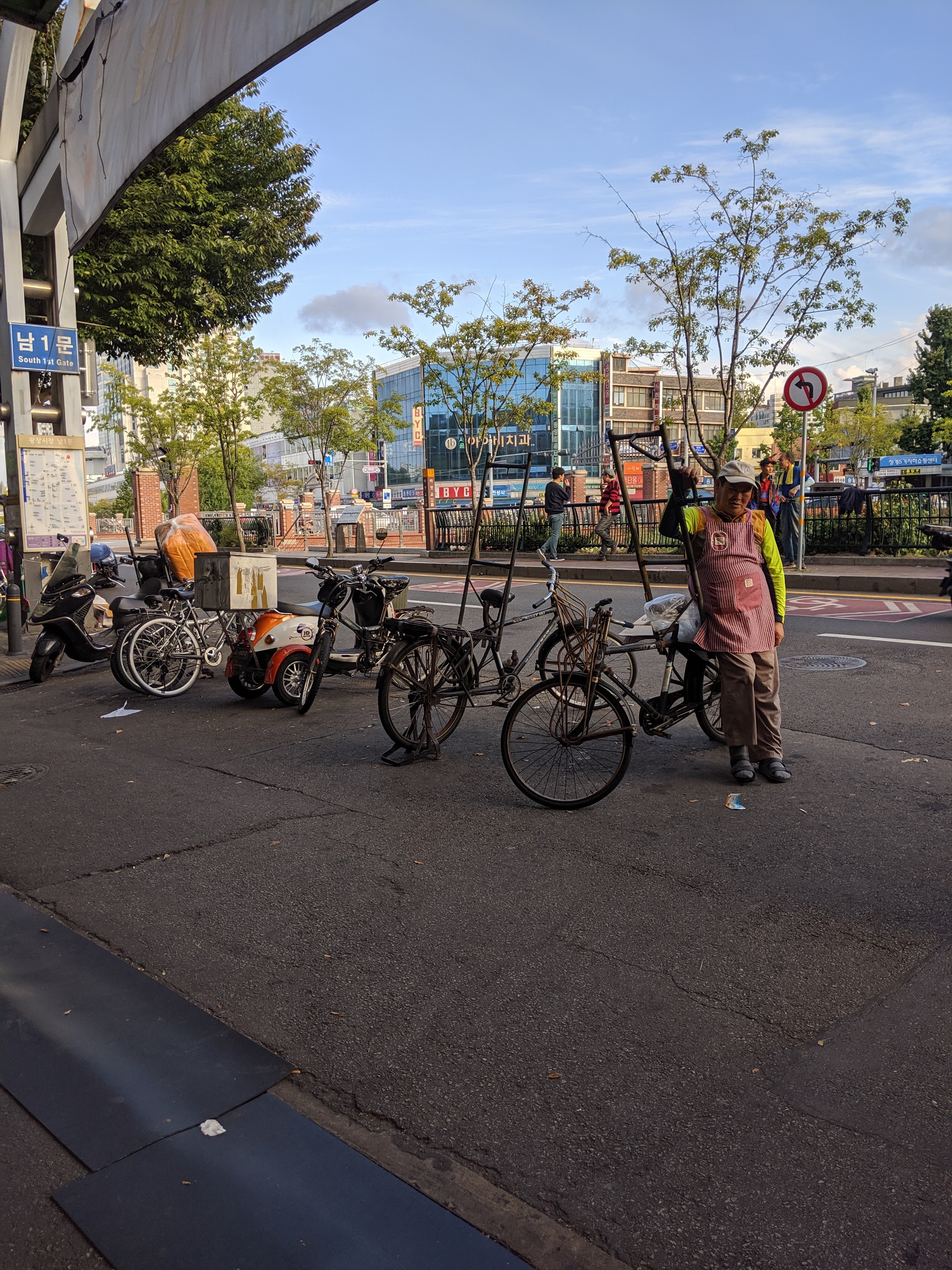
Minji explained what is particularly notworthy is how things are moved about between all the different businesses. Most transport is by bicycle couriers, motorcycle couriers and hand carts. These may be shared by a group of businesses near to each other or they may hire one. Below is an image of some bicycle couriers waiting for business and their adapted bicycles that can carry loads.
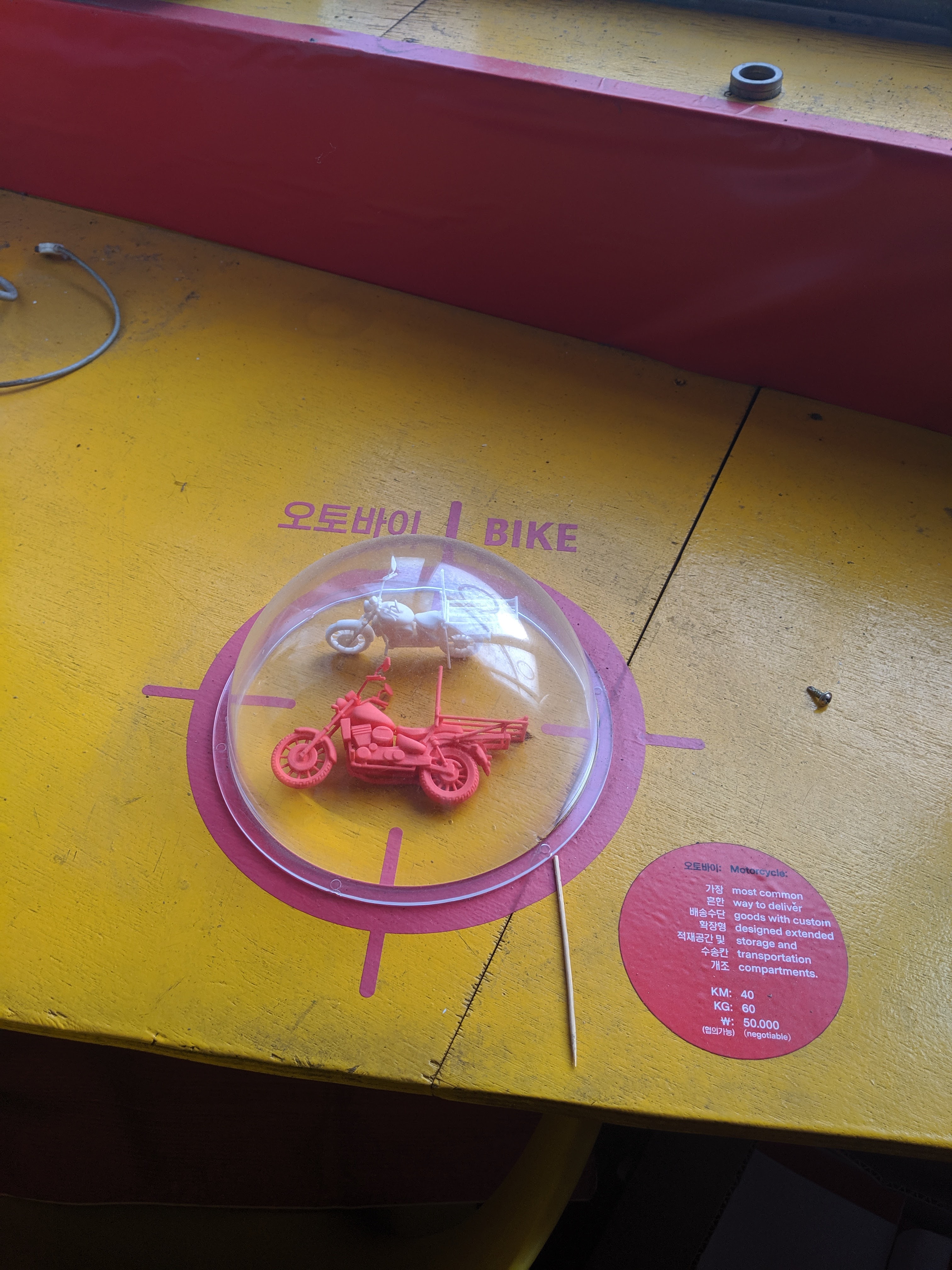
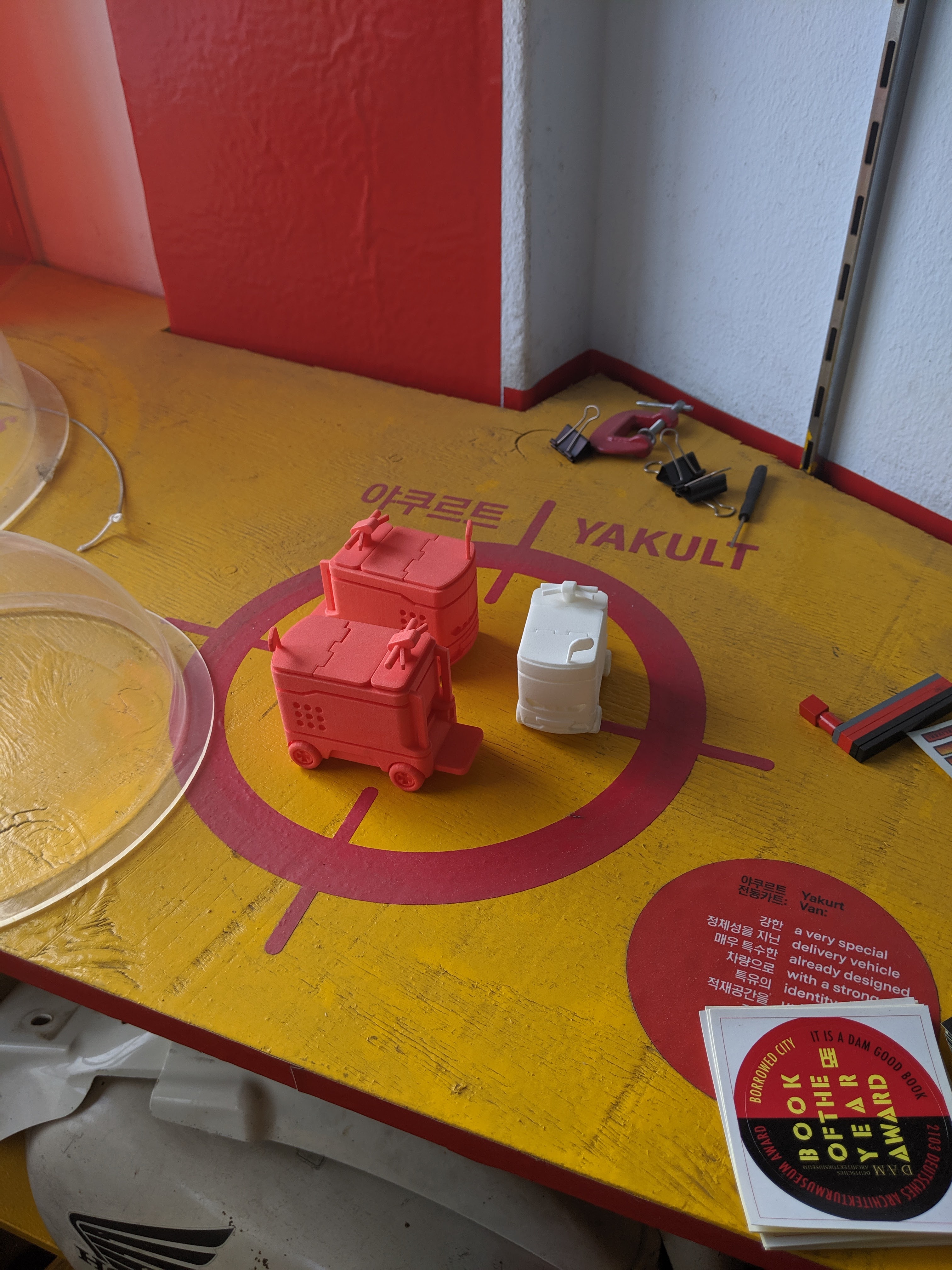
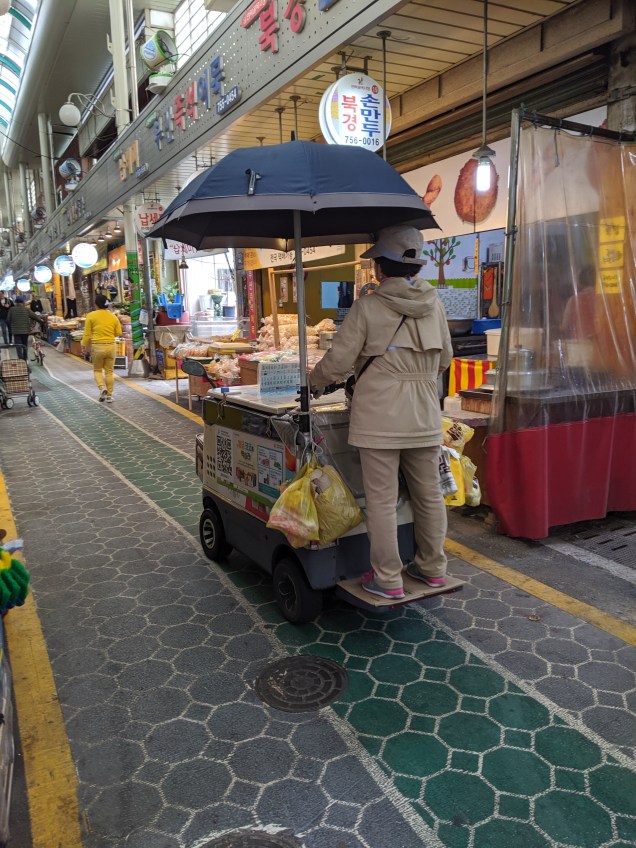
The Motoelastico practice had carried out design studies to model and 3D print the various modes of transport within the neighbourhood. Above was their motorcycle study and below for something that immediately caught my eye – the Yoghurt cart. A cart for yoghurt just sounds mad. How so? Here was one of my learning points for the day. Yoghurt is a big thing to Koreans (and is also popular in Japan where Yakult was invented). It’s a daily snack consumed by almost everyone. These carts and “Yoghurt Ladies”, who pilot them, whizz about in and near to the Maker districts delivering mid-morning and mid-afternoon yoghurt drinks to the workers and business owners. The density of customers and the design of the carts allows sales to happen down narrow walkways, pavements and routes through the neighbourhood. This relationship between density and food and drink delivery reminded me once of seeing someone in Istanbul in a similar district delivering hot tea to workers and shopkeepers along a street from a hand-pushed cart.
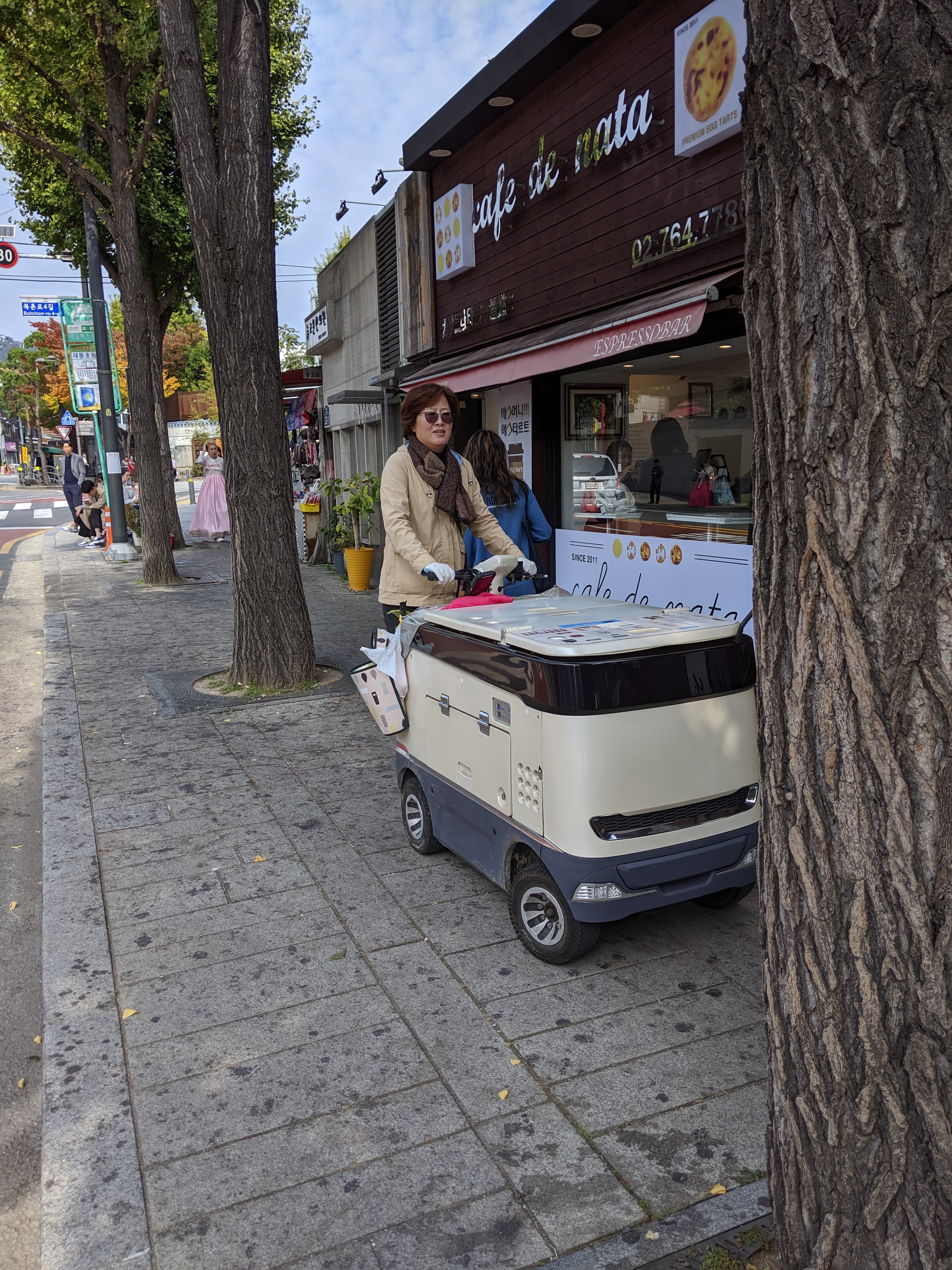
So once we had discussed all things architectural in Seoul (learning conveniently there was an Architecture festival just starting), I bid my goodbyes and then went on the hunt for a yoghurt cart. I just had to see one now that I had been told they were very Korean. So that afternoon my eyes were peeled. Sure enough within barely an hour I spied one. They appeared to be electrically powered and the driver stood on a platform at the back of the cart which had four wheels, the front pair steerable like a car. I was so pleased I saw one for real. Two days later in Busan I saw another cart going about in another market setting, but this one had its own rather fetching umbrella! (second picture below). Clearly this sort of vehicle is suited to the very permeable, intricate, dense urban environment which provided sufficient customers who are willing to pay for the product to be delivered to their premises.
I felt that now after my meeting at Motoelastico, and with the help of Minji and Simone, I was now more informed and aware how the maker districts worked in Seoul and how they were supported by a rather fascinating food delivery mechanism. I then set off on subsequent days to see the rest of Seoul.
Thank you to Minji Kim and the rest of Motoelastico team for hosting my visit.
 Urbanthoughts
Fascinating how in SE asia society has fitted vehicles into cities, whereas in the UK we have adapted streets and suburbs for vehicles. This is partially the result of a realxed view / laisez fare atitude to parking. Whereas in Holland I remember being told that parking spaces are a specific size, which is now too small for many modern vehicles which have grown in size.
LikeLiked by 1 person